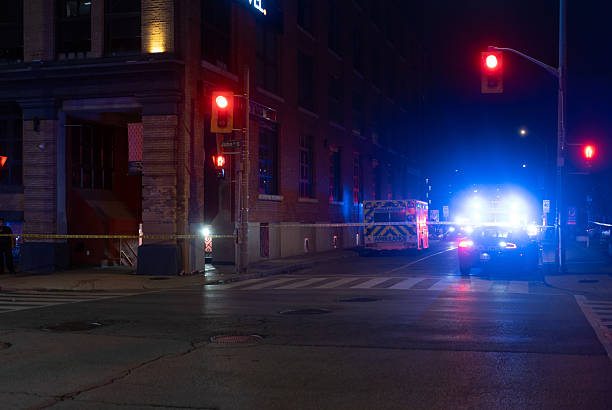
WASHINGTON, D.C. – A chaotic and frightening scene unfolded just outside the most heavily guarded address in the United States on Saturday evening, as two people were shot during an encounter involving the U.S. Secret Service near the White House. The shooting occurred near the intersection of Pennsylvania Avenue and 17th Street Northwest, a high-traffic pedestrian zone that lies just beyond the White House complex’s security perimeter.
The incident, which took place on a weekend evening when tourists and locals typically crowd the area, triggered an immediate security lockdown of the White House grounds, sent members of the press corps scrambling for cover, and prompted a massive emergency response from multiple federal and local law enforcement agencies. At the time of the confrontation, President Donald Trump was reportedly inside the White House residence, though officials later confirmed he was never in danger.
Authorities have not yet released the identities or medical conditions of the two individuals who were shot, nor have they fully clarified the exact sequence of events that led to the exchange of gunfire. What remains clear is that for approximately 30 to 45 minutes on Saturday evening, the heart of American democracy became an active shooter zone.
Timeline of Events: What We Know So Far
According to preliminary statements from law enforcement officials, the incident began sometime shortly before 6:15 p.m. Eastern Time on Saturday. Members of the U.S. Secret Service Uniformed Division — the branch responsible for guarding the White House grounds, its perimeter, and its immediate surrounding streets — received reports of an individual firing a weapon in the area near 17th Street and Pennsylvania Avenue.
That intersection is historically significant and symbolically charged. Pennsylvania Avenue, often called “America’s Main Street,” runs directly in front of the White House, and 17th Street borders the Treasury Department building to the east. The area is typically swarming with tourists taking photos of the White House fence, even during evening hours.
Upon receiving the reports, Secret Service officers responded within moments. Multiple witnesses, including journalists on the White House grounds who were preparing for evening news broadcasts, reported hearing what they initially described as “dozens of gunshots” — though some estimates varied between 8 and 15 rounds. The sound of gunfire echoed off the marble and limestone facades of nearby federal buildings, including the Eisenhower Executive Office Building and the Department of the Treasury.
Witness Accounts: “Get Down! Shots Fired!”
One of the most detailed accounts came from members of the White House press corps, who were stationed in their designated work areas along the northwest side of the complex. Reporters from networks including CNN, Fox News, and the Associated Press described a sudden and terrifying shift from a routine Saturday evening to a life-threatening emergency.
According to multiple pool reports filed immediately after the incident, Secret Service agents suddenly began shouting commands. Witnesses heard agents yell “get down” and issue explicit warnings of “shots fired.” Some journalists reported seeing armed agents carrying rifles — likely the Secret Service’s standard-issue patrol rifles — moving swiftly across the North Lawn, taking tactical positions behind trees, planters, and vehicle barricades.
One freelance journalist who was near the northwest gate told a local affiliate: “I heard the first pop and thought it might be a car backfiring. Then three more pops in quick succession. An agent grabbed me by the arm and pulled me toward a concrete barrier, shouting, ‘Move now!’ I’ve never run that fast in my life.”
Within minutes, members of the press corps were quickly escorted into secure areas inside the White House briefing room and adjacent corridors. The Secret Service activated its emergency lockdown protocols, which include magnetically locking exterior doors, raising all vehicle barriers, and deploying additional tactical units from the Secret Service’s Counter Assault Team (CAT), which is trained for active shooter scenarios.
President Donald Trump Inside Residence
As the shooting unfolded, one question dominated every official channel and news alert: Where was the president?
According to multiple agencies and initial statements from the Secret Service, President Donald Trump was inside the White House residence at the time of the incident. The residence is located on the second and third floors of the White House, positioned well behind the North Lawn and protected by multiple layers of security, including bulletproof windows, blast-resistant walls, and a constant detail of Secret Service agents.
While the president was never evacuated, standard protocols were likely activated, including moving him to a secure location within the residence — either the Presidential Emergency Operations Center (PEOC) in the basement or a hardened safe room. The White House has not disclosed the president’s exact movements during the shooting, citing ongoing operational security reviews.
Presumably, President Trump was briefed on the situation in real-time by his Secret Service detail leader, who has the authority to order an evacuation via helicopter (Marine One) or motorcade if the threat level escalates. No such evacuation occurred, indicating that officials quickly determined the threat was contained to the perimeter.
Lockdown and Lifting of Security Protocols
For approximately 30 to 45 minutes, the White House complex was in a state of full lockdown. No one was permitted to enter or exit the grounds. Staff, journalists, and any visitors who happened to be on pre-scheduled tours were instructed to remain in place, away from windows and exterior doors.
The lockdown was eventually lifted shortly after 6:45 p.m. ET, according to a notification sent to the White House press corps. However, the lifting of the lockdown did not mean the scene had returned to normal. Law enforcement officials continued to restrict access to the streets immediately surrounding the White House, including large sections of Pennsylvania Avenue, 17th Street, and Constitution Avenue.
Agents with the Metropolitan Police Department (MPD) — Washington, D.C.’s local police force — established a wider perimeter, rerouting traffic and pedestrians for several blocks in every direction. Emergency responders from D.C. Fire and EMS were staged at a nearby command post, though it remains unclear whether they transported the two shooting victims to a local hospital or whether treatment was provided on scene.
The Two Victims: Unknown Identities and Conditions
The most significant gap in public information concerns the two individuals who were shot. As of this publication, authorities have not yet released detailed information regarding the identities or conditions of these two people.
Critical unanswered questions include:
· Were the two individuals the person who was reportedly firing a weapon, or were they bystanders?
· Were they shot by Secret Service agents, or did they sustain injuries from another source (e.g., self-inflicted or crossfire)?
· What are their current medical conditions — stable, critical, or deceased?
· Are they adults or minors? Residents of Washington, D.C., or tourists?
Law enforcement officials have stated that notifications to next of kin are ongoing, which is standard procedure in any shooting investigation. Until those notifications are complete, federal privacy laws and departmental policies generally prevent the release of names, ages, or medical statuses.
What is known is that two people were shot during an encounter involving the U.S. Secret Service. The phrase “encounter” is significant in law enforcement terminology — it suggests an active confrontation, not a passive shooting. This implies that Secret Service officers likely engaged the individual who was firing a weapon, and that the two victims may include that suspect and possibly one other person, such as a bystander or an accomplice.
The Investigation: Multiple Agencies, One Unified Command
The investigation into the shooting is being led by a coalition of agencies, each with distinct jurisdictions but overlapping responsibilities. The primary agencies involved include:
· U.S. Secret Service (USSS): As the agency whose officers fired their weapons (presumably), the Secret Service will conduct an internal use-of-force investigation. This is standard for any shooting involving federal law enforcement.
· Metropolitan Police Department (MPD): As the local law enforcement agency for Washington, D.C., MPD has jurisdiction over the crime scene outside the immediate White House fence line. They will investigate any criminal charges that may arise.
· D.C. Office of the Chief Medical Examiner: If either victim dies, the ME’s office will conduct autopsies and rule on cause and manner of death.
· Federal Bureau of Investigation (FBI): Because the shooting occurred on federal property or adjacent to it, the FBI may be called in to assist with ballistics, forensics, and any potential terrorism nexus.
Officials are expected to release additional details as the investigation develops, likely through a joint press conference scheduled for Sunday morning or early afternoon. That press conference may include body-worn camera footage (if any Secret Service officers were equipped with such devices), surveillance video from Treasury Department cameras, and a more precise timeline.
Widespread Concern and Public Reaction
The scene caused widespread concern due to its proximity to one of the most heavily secured areas in the country. In any other city, a shooting that leaves two people injured is tragic but not unprecedented. However, when gunfire erupts within earshot of the White House — a building that symbolizes American governance and global power — the psychological impact is magnified tenfold.
Tourists who were visiting Washington, D.C., for the weekend took to social media to share their experiences. One family from Ohio posted a video showing dozens of people running away from the Ellipse, a park just south of the White House. Another person tweeted: “I heard the shots while eating dinner at a restaurant on 18th Street. Everyone hit the floor. Waiters were crying. We didn’t know if this was an attack.”*
Local residents, many of whom have grown accustomed to the constant presence of Secret Service and police, expressed a mix of shock and resignation. “You live near the White House, you know something could happen,” said a resident of Foggy Bottom who declined to give her name. “But you never actually expect to hear gunfire. It’s supposed to be the safest place in America.”
Historical Context: Previous White House Shootings
Saturday’s shooting is not the first time gunfire has erupted near the White House. Notable previous incidents include:
· 1994: A man fired a semiautomatic rifle from outside the White House fence, striking the building.
· 2011: A man fired multiple rounds at the White House from an assault rifle; no one was hit, but a bullet struck a residence window.
· 2016: A man with a weapon was shot and wounded by Secret Service at a security checkpoint.
· 2023: A driver crashed a truck into a security barrier near the White House; no shots were fired but the incident raised security concerns.
Each of these incidents led to reviews and upgrades of White House security protocols, including higher fences, expanded restricted zones, and increased patrols. Saturday’s shooting will almost certainly lead to yet another review, particularly regarding how an individual was able to fire a weapon so close to the complex.
What Happens Next
In the coming days, the public can expect:
1. Identification of the two shooting victims, once families are notified.
2. Clarification of the sequence of events — specifically, who fired first, how many rounds were discharged, and whether the suspect was known to law enforcement.
3. A statement from the Secret Service regarding any injuries to its own personnel (none have been reported as of this writing).
4. Possible body-camera or surveillance footage released through public records requests or at a press briefing.
5. Security modifications around the White House perimeter, possibly including additional vehicle barriers or metal detectors.
President Trump has not yet made a public statement regarding the shooting, though it is likely that he will address it during a scheduled event or via social media within 24 hours.
Conclusion: A City on Edge
For the nation’s capital, a city that has grown weary of security alerts, lockdowns, and high-profile threats, Saturday evening’s shooting near the White House was a stark reminder that no place — not even the president’s front lawn — is entirely immune from violence.
Two people are shot. Dozens of gunshots heard. Armed agents running across the North Lawn. A president inside the residence. A lockdown, then lifted. And now, an investigation that will stretch for weeks or months.
As officials continue to investigate the situation, and as more details emerge from the Secret Service, Metropolitan Police Department, and emergency responders who rushed toward the danger, one thing is certain: the intersection of Pennsylvania Avenue and 17th Street Northwest will never feel quite as safe again.
Leave a Reply