CONCORD, NORTH CAROLINA — The motorsport world received a devastating blow this morning when the family of two-time NASCAR Cup Series champion Kyle Busch officially revealed the cause of his sudden, shocking death. In a statement released Saturday, May 23, 2026 — just two days after he passed — the Busch family confirmed that what began as what appeared to be a manageable respiratory illness spiraled with terrifying speed into a fatal medical emergency.
“The medical evaluation provided to the Busch Family concluded that severe pneumonia progressed into sepsis, resulting in rapid and overwhelming associated complications,” the family said in the statement, which was delivered to media by Dakota Hunter, Vice President of Kyle Busch Companies.
The family added: “The Family asks for continued understanding and privacy during this difficult time.”
Those two sentences, quiet and measured in their grief, drew a curtain over the most stunning death in NASCAR history in decades — a titan of the sport, a man who had strapped himself into a race car just four days earlier to win a Trucks Series event at Dover Motor Speedway, gone in less than 72 hours.
Kyle Thomas Busch was 41 years old.
A Death Nobody Saw Coming
The timeline of Kyle Busch’s final days has emerged piece by piece over the last 48 hours, each detail adding to the profound sense of tragedy and disbelief felt across the sporting world.
The earliest warning sign, in hindsight, came as far back as May 10, when Busch was racing at Watkins Glen International. Sources close to the team indicated he was believed to have been battling a sinus cold at the time, and during the event he radioed his crew requesting medical attention after the race. At the time, no one gave it a second thought. Drivers fighting through illness, pain, and discomfort is as old as motorsport itself. The culture of NASCAR — of all racing — has always demanded that competitors push through. Busch, whose toughness and ferocity behind the wheel were the stuff of legend, was not the kind of man who sat out.
And so he didn’t. He pressed on.
Just days later, he was back behind the wheel at Dover Motor Speedway, where, on the weekend of May 17–18, he did what Kyle Busch always seemed to do under pressure: he won. Busch took the Trucks Series race at Dover — a victory that, though nobody could have known it at the time, would be the final checkered flag of his career. That same weekend he finished 17th in the NASCAR All-Star Race at Dover, meaning he had been visibly active and competitive just five days before his death.
On Wednesday, May 20, Busch arrived at the General Motors Charlotte Technical Center in Concord, North Carolina — the cutting-edge facility where NASCAR teams use advanced Chevrolet racing simulators to prepare for upcoming races. He was gearing up for the Coca-Cola 600 at Charlotte Motor Speedway, scheduled for Sunday, May 24 — one of NASCAR’s crown jewel events, run over Memorial Day weekend and historically one of the most prestigious races on the calendar.
What happened inside that facility changed everything.
The 911 Call That Changed Everything
A 911 call, obtained by USA Today and the Associated Press, revealed in harrowing detail the moment the crisis unfolded. An unidentified male caller reached emergency dispatchers from inside the GM Charlotte Technical Center. According to the call, Busch was found on the floor of a bathroom inside the facility, conscious but in visible and severe distress.
The caller described Busch as having “shortness of breath,” feeling “very hot,” believing he was “going to pass out,” and — most alarmingly — “coughing up blood.”
The caller directed dispatchers to the facility and made an unusual, telling request: he asked that emergency responders arrive without their sirens on. The specificity of that detail — the need for discretion even in a medical emergency — underscored the surreal nature of the moment. This was Kyle Busch, one of the most recognizable athletes in American motorsport, collapsed on a bathroom floor of a racing facility days before one of the most important races of his season.
Emergency services responded. Busch was transported from the GM facility to a hospital in Charlotte. He was alive, but the situation was grave.
On Thursday morning, May 21, his family and team Richard Childress Racing issued an initial statement confirming Busch had been hospitalized with a “severe illness” and would not compete in the Coca-Cola 600. The statement was alarming but left the severity of the situation ambiguous. People speculated about recovery timelines. Fans flooded social media. The NASCAR paddock buzzed with concern.
Hours later, there was nothing left to speculate about.
NASCAR, Richard Childress Racing, and the Busch family released a joint statement. Kyle Busch had died. He was 41.
The Science Behind the Killer: What Is Sepsis?
The cause of death — severe pneumonia that progressed into sepsis — deserves explanation, because the speed with which it can kill is still, even in 2026, something many people underestimate.
Pneumonia is an infection that inflames the air sacs in one or both lungs, which can fill with fluid or pus. Most healthy adults recover from pneumonia with treatment. But in some cases — particularly where the infection goes undetected or undertreated — it can reach a critical threshold.
Sepsis occurs when the body launches an extreme, catastrophic immune response to an existing infection. Rather than fighting only the invading pathogen, the immune system goes into full-system overdrive. It begins attacking the body’s own tissues and organs. The results are devastating: widespread inflammation, microscopic blood clots forming throughout the vascular system, blood vessels leaking, oxygen failing to reach vital organs. The heart, kidneys, liver, and lungs can begin to fail in rapid succession.
According to the Centers for Disease Control and Prevention (CDC), sepsis is one of the leading causes of death in hospitals in the United States. Roughly 1.7 million American adults develop sepsis every year, and approximately 350,000 die from it. It can strike fast — in some cases, patients can deteriorate from stable to critical within hours.
In Busch’s case, it appears the pneumonia was building silently even as he was racing, winning, and preparing for his next event. By the time he collapsed at the GM facility, the sepsis had likely already taken hold with devastating momentum.
A Career Unlike Any Other
To understand the full weight of this loss for NASCAR and for American motorsport, one must reckon honestly with what Kyle Busch accomplished over his 22 seasons of full-time Cup Series competition.
Born May 2, 1985, in Las Vegas, Nevada, Busch learned to drive a go-kart at six years old — his father would operate the gas pedal while young Kyle steered. That early introduction to racing ignited something that could not be extinguished. By his teenage years, he was dominating local and regional circuits. By 18, he was in NASCAR’s top series.
He won his first Cup Series race in 2005 at Auto Club Speedway in Fontana, California — the same track where, years later, he would break a record that had stood for nearly half a century. Kyle Busch won a Cup race in 19 consecutive seasons — shattering a mark he shared with the sport’s greatest icon, Richard Petty, who had done it across 18 seasons. The record was broken in 2023, Busch’s first year with Richard Childress Racing after his long and decorated tenure with Joe Gibbs Racing.
His Cup Series championship résumé is remarkable: back-to-back title contention years, a championship in 2015 that came after one of the most dramatic comeback narratives in NASCAR history — he had broken his right leg and left foot in a crash at Daytona in February of that year and missed the first 11 races of the season, only to return, qualify for the playoffs on a waiver, and win it all. He won the title again in 2019.
Across NASCAR’s three national series — the Cup Series, the Xfinity Series, and the Craftsman Truck Series — Kyle Busch amassed a staggering 234 total wins, a number that is the all-time record across all three series combined. His 63 Cup Series wins rank ninth all-time. His 102 Xfinity Series victories are the all-time record in that series. His 69 Truck Series wins are the all-time record there too. No other driver in the modern era has dominated across all three tiers of NASCAR competition the way Busch did.
He was, in every measurable sense, the greatest multi-series winner in NASCAR history.
His final Cup Series victory came at World Wide Technology Raceway at Gateway in 2023. His final win of any kind was the Trucks Series race at Dover on May 17–18, 2026 — four days before his death.
“Rowdy Nation” in Mourning
Kyle Busch was not always loved. For much of his career, his relationship with NASCAR fans was complicated, even adversarial. He was supremely confident, occasionally brash, and competed with an intensity that some found difficult to root for. He was not a “good ol’ boy.” He was Las Vegas by way of NASCAR, and he made no apologies for it.
He embraced the villain role, leaned into the nickname “Rowdy,” and over time did something extraordinary: he won the crowd over anyway. The “Rowdy Nation” — his passionate and loyal fanbase — grew from a cult following into one of the largest and most devoted in the sport. By the end of his career, even those who had booed him loudest had come to appreciate what they were watching.
NASCAR CEO Steve O’Donnell spoke for the sport in the hours after Busch’s death: “Sudden and tragic. Our hearts go out to the Busch family.”
The joint statement from the Busch family, Richard Childress Racing, and NASCAR said: “A future Hall of Famer, Kyle was a rare talent, one who comes along once in a generation. He was fierce, he was passionate, he was immensely skilled and he cared deeply about the sport and fans. Throughout a career that spanned more than two decades, Kyle set records in national series wins, won championships at NASCAR’s highest level and fostered the next generation of drivers as an owner in the Truck Series. His sharp wit and competitive spirit sparked a deep emotional connection with race fans of every age, creating the proud and loyal ‘Rowdy Nation.’”
The racing world beyond NASCAR responded with equal force. J. Douglas Boles, president of IndyCar, announced on social media that the pylon at the Indianapolis Motor Speedway would be lit on Lap 18 of the Indianapolis 500 in memory of Kyle Busch — a gesture of cross-series solidarity that underscored just how large a figure Busch had become in American motorsport as a whole.
The No. 8 Will Race No More — For Now
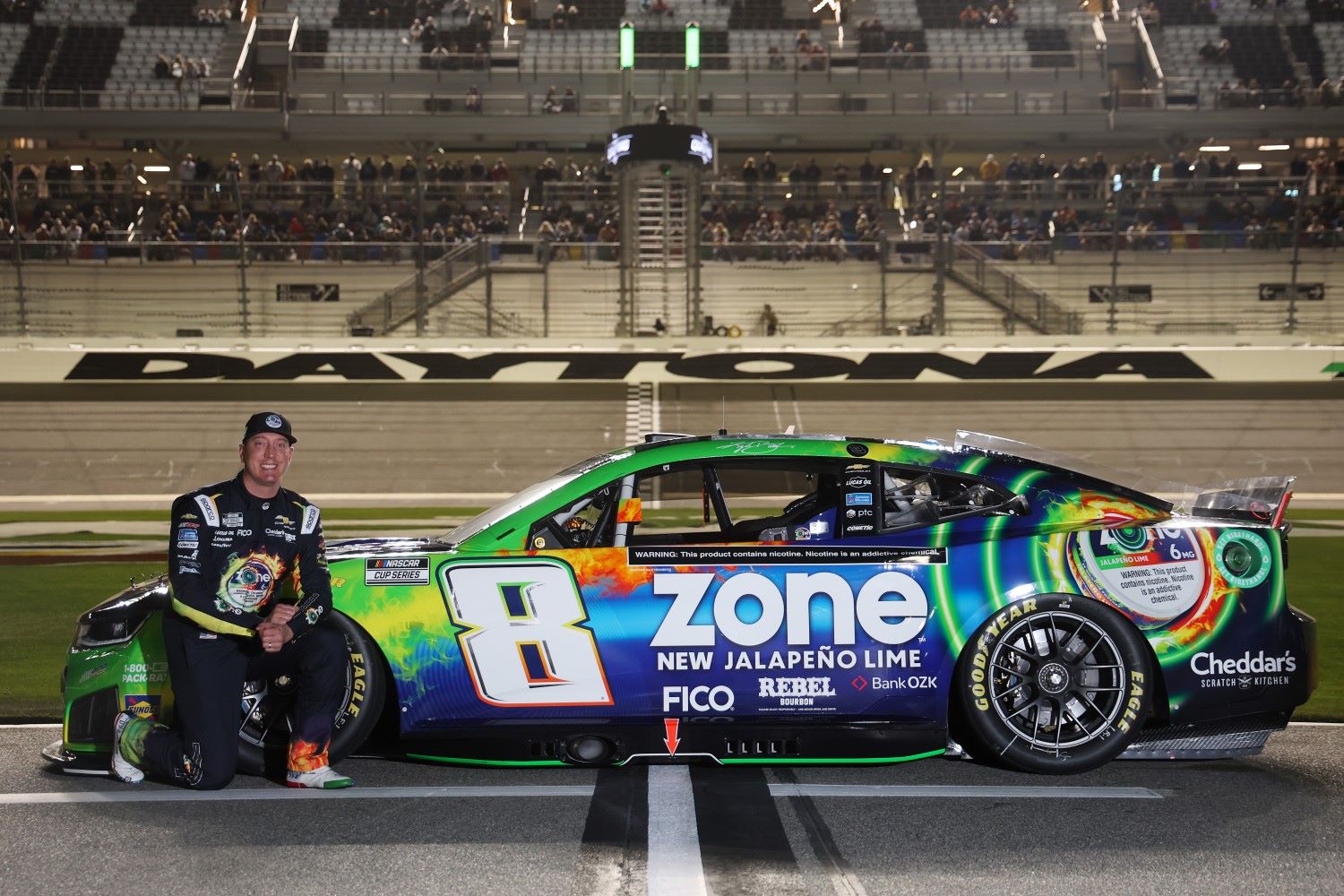
Richard Childress Racing, the team Busch had driven for since leaving Joe Gibbs Racing ahead of the 2023 season, announced on Friday, May 22, that it would retire Busch’s No. 8 for the remainder of the 2026 season. The team will compete under the No. 33 for the rest of the year, with Austin Hill driving the car at Charlotte on Sunday, May 24.
Plans for the longer term — whether the No. 8 will be permanently retired, whether RCR will name a permanent replacement, whether there will be any structural changes to the team going forward — have not yet been confirmed. The organization said further announcements would be made when appropriate.
At Charlotte Motor Speedway this Saturday, the pre-race atmosphere has been one of subdued reverence. A massive LED tribute screen at the track has displayed images and video of Busch’s career highlights. Flowers and memorabilia have been left outside the main gates by fans who traveled to Charlotte not to watch a race, but to grieve at the place where the race Busch was supposed to run was still going ahead.
NASCAR confirmed it would not cancel the Coca-Cola 600, a decision that drew mixed reaction. Some fans called for a postponement or cancellation as a mark of respect. NASCAR officials argued that going ahead with the race — and honoring Busch within it — was the more fitting tribute, given his own fierce dedication to the sport.
The Family He Leaves Behind
Kyle Busch is survived by his wife, Samantha Busch, and their two children: son Brexton, born in 2015, and daughter Lennix, born in 2022. The family’s journey to have children was publicly and emotionally documented — Samantha Busch became a prominent advocate for IVF awareness and infertility support, writing a book on the subject and using her platform to support others going through similar struggles.
Brexton, at 10 years old, is already showing the racing instincts of his father, having been spotted at tracks around the country in small cars from the time he could walk. The image of Brexton strapped into a tiny kart with his father’s intensity on his face has circulated widely on social media over the past 48 hours as the racing community grapples with its grief.
Kyle Busch’s brother, Kurt Busch — himself a former NASCAR Cup Series champion (2004) — has not yet made a public statement. Kurt Busch stepped away from full-time competition following a concussion injury in 2022, and the brothers remained close.
Tributes Pour In From Across the World
Social media and the NASCAR world have been awash with tributes since Thursday’s announcement, and those messages have only intensified following today’s confirmation of the cause of death. Drivers current and retired, team owners, racing officials, and fans from around the globe have posted their remembrances.
Fans also responded with charitable donations to foundations associated with Busch’s name, offering symbolic gestures of love to a man who spent over two decades pouring everything he had into the sport.
Kyle Busch’s death — sudden, swift, and at an age when most of his peers are still racing at full capacity — has shocked the NASCAR world in a way nothing has in many years. He was not ill in any visible public sense. He was not winding down. He was, as recently as last Sunday, winning races and preparing for the greatest race of the Memorial Day weekend calendar.
Sepsis does not announce itself. It does not give warning. It does not ask whether the person it is claiming is a legend, a father, a husband, or a son.
As Charlotte Motor Speedway prepares to host the 2026 Coca-Cola 600 on Sunday without its most anticipated competitor — the man who was set to line up three days ago — the grief hanging over the sport is palpable and total.
The Rowdy Nation has gone quiet.
Kyle Busch. May 2, 1985 – May 21, 2026. Age 41. Two-time NASCAR Cup Series Champion. All-time NASCAR wins record holder across all three national series. 234 victories. Forever Rowdy.
Sources: NASCAR, Richard Childress Racing, Associated Press, USA Today, ESPN, NPR, Jayski, Washington Post, GBH News, ABC7.